

The Octopus issue 🐙
Intelligence, delicacy and the hidden costs of a global seafood trade
Hello,
In 2023, we investigated the octopus trade, tracing its journey from Mauritanian waters to plates in Spain and Japan and asking a simple question: should we still be eating octopus? The reporting was published, among other outlets, in Süddeutsche Zeitung.
It is a story about how global demand, declining wild stocks and new science on octopus intelligence collide – and what is lost when an alien form of intelligence is reduced to an industrial commodity.
Since then, ocean politics has caught up. In January 2026, the United Nations’ High Seas Treaty entered into force, committing countries to protect 30% of the oceans by 2030. The timing is notable, as debates over exploitation, ethics and unfamiliar forms of intelligence beneath the surface are becoming harder to ignore.
Below is the English translation of the article.
Should We Still Eat Octopus?
They play a vital role in the marine ecosystem and are considered highly intelligent. And they are a prized delicacy, from Japan to Spain. Soon, it may even be possible to farm them. Can aquaculture solve the octopus dilemma?
In the port of Nouadhibou, Mauritania’s second-largest city, 48-year-old fisherman Atigh Boucavar leans exhausted against a stack of octopus traps.
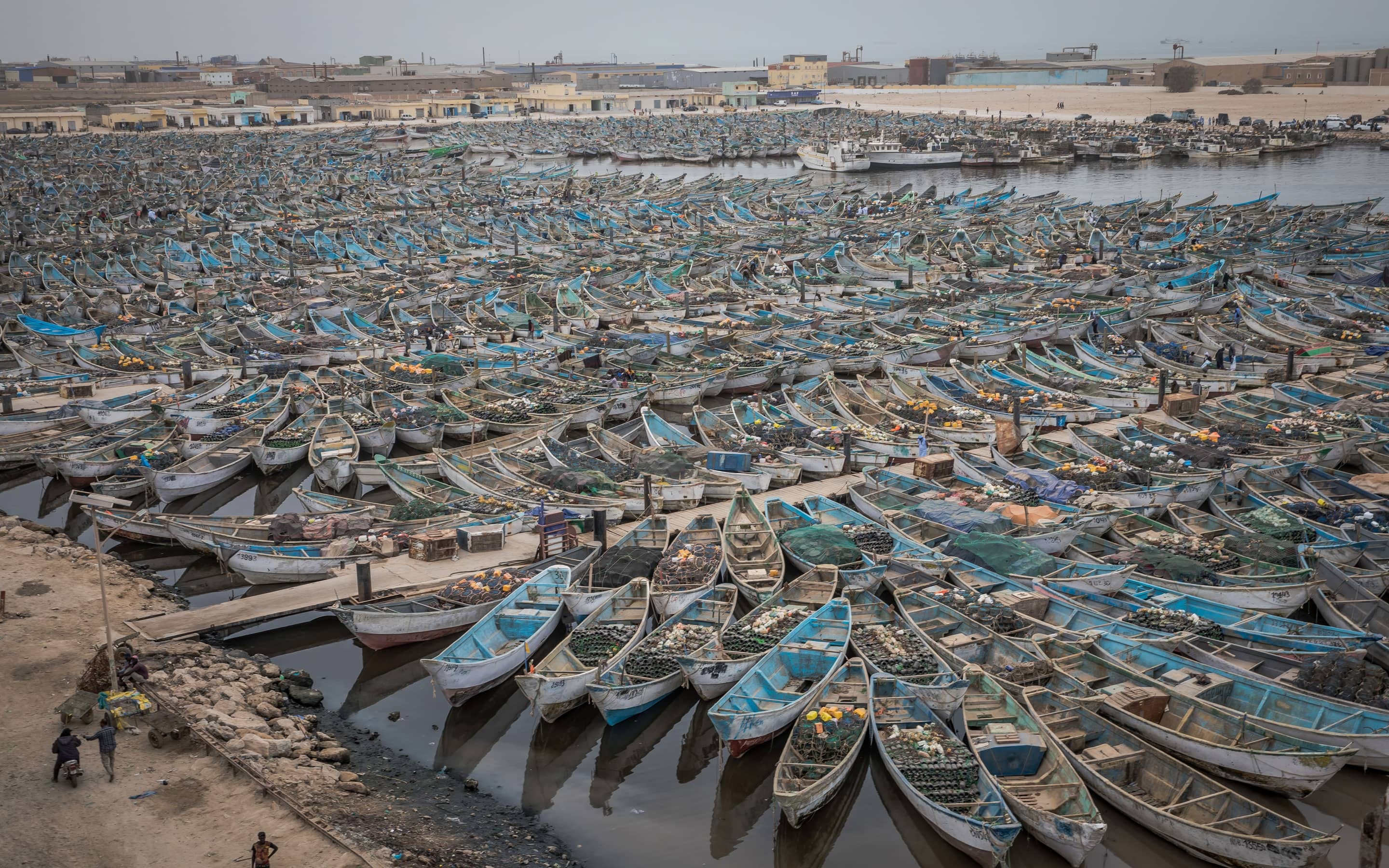
Around him, chaos reigns. Dockworkers load boats with engines, diesel barrels and bags full of baguettes for provisions. Thousands of blue-and-white pirogues – traditional small boats –bob in the water. Fishermen lug sacks filled with freshly killed octopus to traders on the quay. The stench of rotting fish waste hangs heavily in the air.
Boucavar and his six-man crew often spend up to twenty days at sea. They earn just under five euros per kilo of octopus caught, which they divide among themselves. But more and more often they return empty-handed. Competition is fierce.
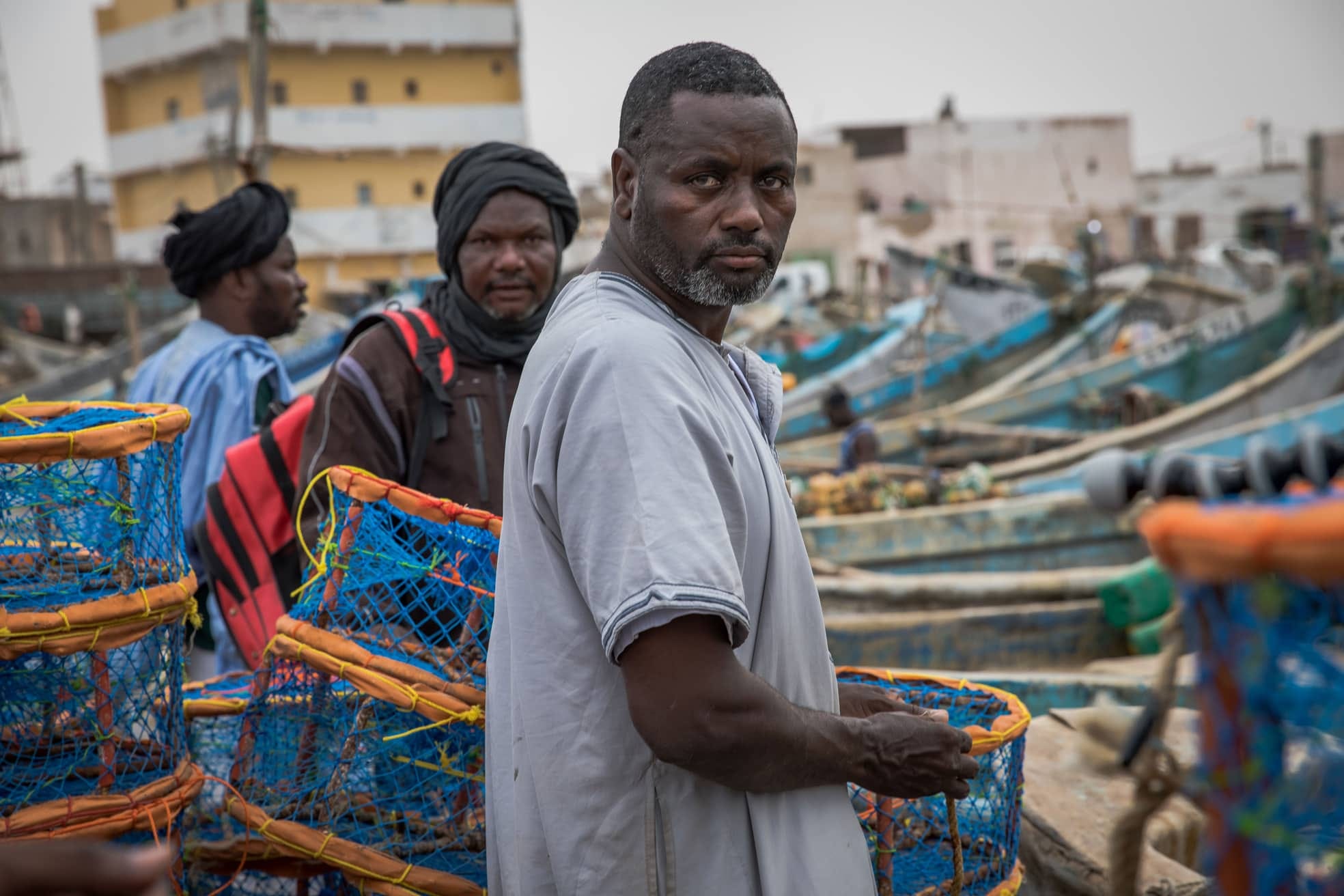
Mauritania is home to the world’s largest artisanal octopus fishery. Around 50,000 fishermen operate a fleet of 7,500 pirogues, targeting primarily Octopus vulgaris, the common octopus.
“I have no other choice,” says Boucavar as he repairs an octopus trap. “I have to go to sea to survive.”
He gazes toward the horizon, where the silhouettes of massive trawlers and fishing vessels belonging to foreign fishing companies loom in the haze. Boucavar believes they are plundering the sea. “We fishermen are the losers here,” he says. “I earn just enough to scrape by.”
The marine animals are transported in ice-cooled crates to one of the city’s more than fifty processing plants.
Nouadhibou, a city of 140,000 inhabitants, is the beating heart of Mauritania’s economy, even if its dusty appearance suggests otherwise. Each year, the desert state exports around 30,000 tonnes of octopus meat, mainly to Spain and Japan.
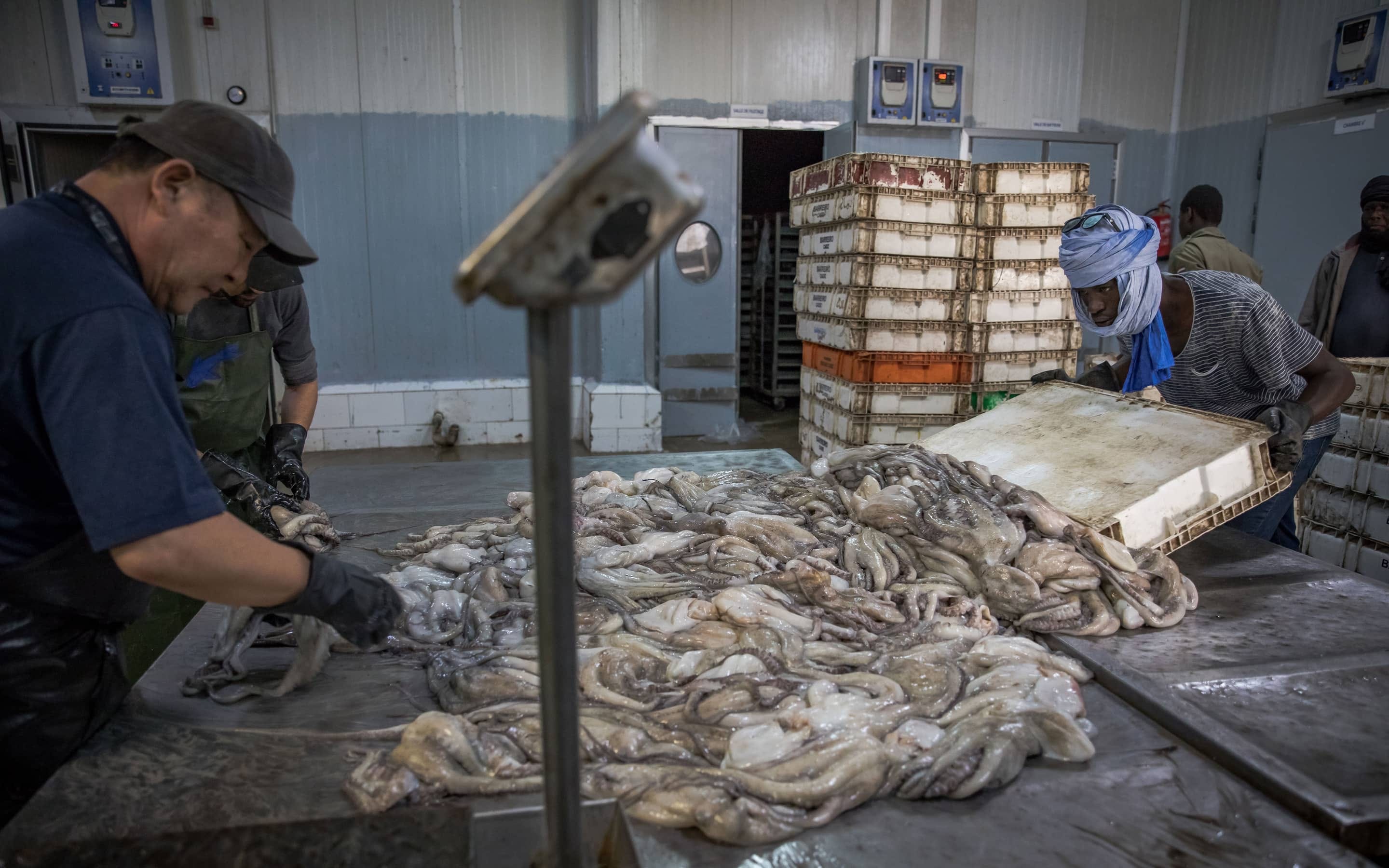
Octopus vulgaris lives at depths of up to 250 metres off Mauritania’s coast. With its blue blood, three hearts and eight arms – which house two-thirds of its 500 million nerve cells – it is one of the most fascinating creatures in the animal kingdom. In 2021, researchers at the London School of Economics concluded in a meta-analysis of 300 studies that cephalopods are sentient and should therefore fall under animal welfare legislation for vertebrates. The studies found “strong scientific evidence” that these animals can experience pleasure, excitement and joy – but also pain and grief.
Octopuses are considered highly intelligent – and a delicacy. Whether grilled, in a Hawaiian poke bowl, as tapas or sushi, octopus is in demand worldwide. Not only in Asia and the Mediterranean, but increasingly in the United States as well. Global catches increased more than tenfold between 1950 and 2018, with around 380,000 tonnes taken from the ocean. Most of the octopus consumed in Europe comes from West Africa. Spain – particularly the northwestern fishing region of Galicia – dominates EU trade.
Spain
In the Galician town of O Carballiño, octopus preparation is a tradition. In the 16th century, monks from the nearby Cistercian monastery of Santa María de Oseira who were paid in dried octopus by their tenants invented the classic tapas dish pulpo á feira.
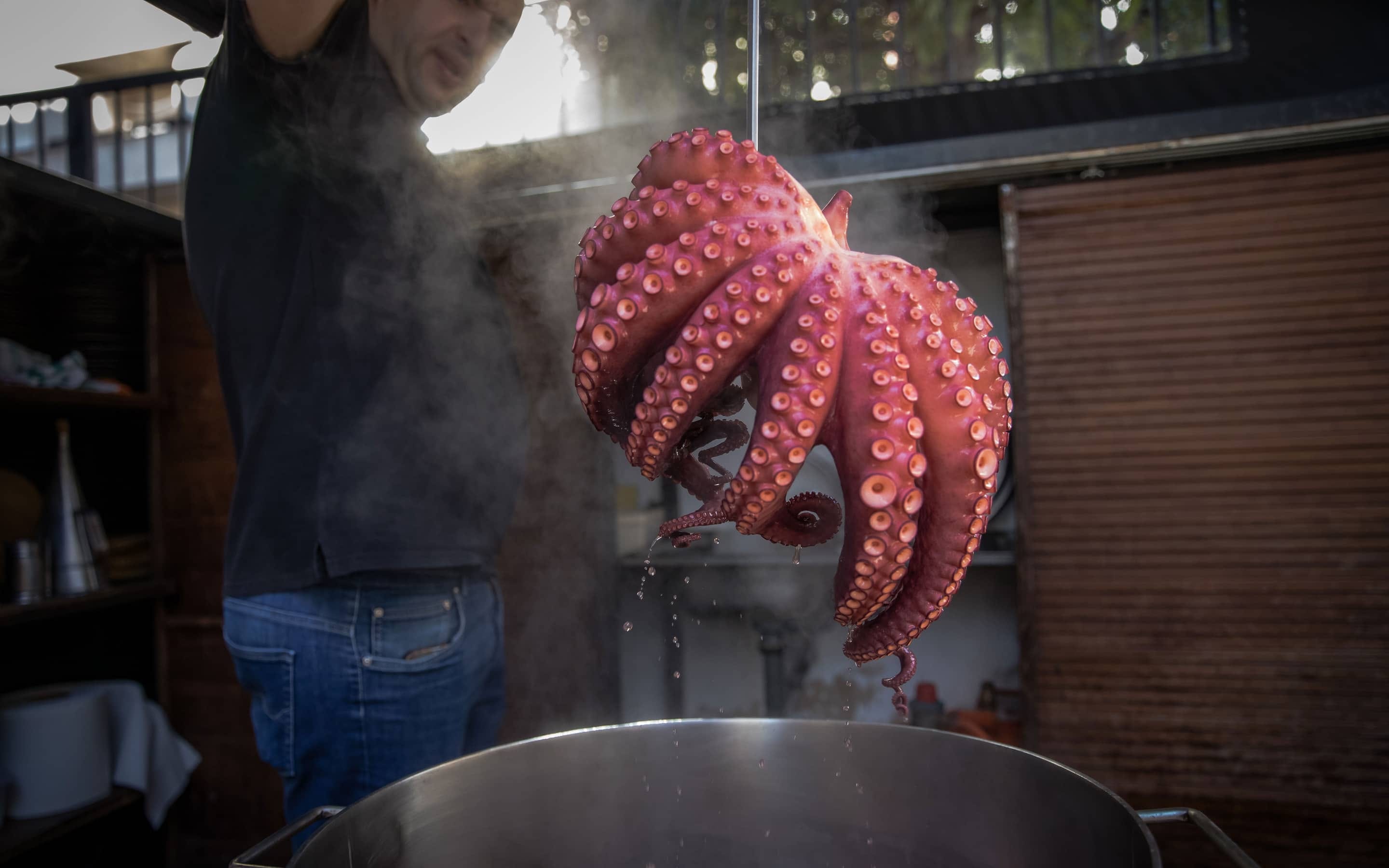
The cephalopod is cooked in a cauldron until the flesh and water turn blood-red. It is then served chopped on wooden plates.
O Carballiño alone has more than a dozen pulperías that prepare the dish in the traditional way. One of them belongs to Daniel González Atanes. The 49-year-old restaurateur and entrepreneur speaks quickly and smiles often. He continues the family octopus-processing business A Pulpeira in its fourth generation. Even outside the factory hall on the outskirts of town, visitors are greeted by an intense smell: the sweet, penetrating scent of cooked octopus. The company processes around 800 tonnes of octopus annually.
Atanes leads the way through the factory. Crates containing 300 tonnes of frozen octopus are stacked to the ceiling in the cold store.


Not for the faint-hearted: once thawed, the grey-pink animals spill from a steel centrifuge after being washed and spun, resembling entrails.
In the slaughterhouse, workers remove the internal organs, cut off the heads and separate the eight arms.
The octopus arms are then vacuum-packed and placed into a gigantic pressure cooker. There, the tentacles simmer in their own juices until they take on the deep red colour that gourmets around the world adore.
The octopus arms are also exported to countries where pulpo was once rarely found on the menu, such as the UK, Germany or the US. As across the Mediterranean, Galicia itself catches ever less octopus. In 2021, EU countries therefore imported more than 100,000 tonnes of octopus worth €972 million. Eighty percent came from Mauritania and Western Sahara. “That’s where the ‘Japanese quality’ comes from, which is all we use here,” says Atanes.
Mauritania
2,700 kilometres further south, in Mauritania. At a lonely petrol station called Gare du Nord, halfway between Nouadhibou and the capital Nouakchott, Babana Yayha Emhamed sips sweet mint tea. The desert stretches to the horizon on both sides of the asphalt road, broken only by a few tents. Mauritania lies on the edge of the Sahara and is three times the size of Germany.
“Mauritanians are born with their backs to the sea,” says Emhamed, Inspector General at the Ministry of Fisheries and Maritime Economy. “They are nomads – with camels, cattle, goats and sheep. They know nothing about the sea.”
But devastating droughts in 1970 and 1984 drove people en masse to the coast. It was there that they discovered the immense wealth of marine resources, says Emhamed. The coastline stretches over 700 kilometres, from Western Sahara in the north to Senegal in the south, and is among the richest fishing grounds in the world.
The cold Canary Current meets the Gulf of Guinea here. The upwelling of cool, nutrient-rich water stimulates plankton growth, creating a fertile coastal ecosystem. Sea bream, mackerel, tuna, seabass, sardines, sharks and lobsters thrive here. And of course, octopus.
Fishing has become the country’s second-largest economic sector after iron ore mining.
Mauritania grants fishing licences to massive trawlers from China, Russia, Ukraine, Turkey and Europe. They mainly catch small sardines that are processed into fishmeal for animal feed. Vessels – often using destructive bottom trawling – also dominated octopus fishing.
But in 2012, the Mauritanian government intervened. Since then, octopus fishing has been reserved for Mauritanians. “Because of its market value and how easy it is to catch, Octopus vulgaris is extremely lucrative,” says Emhamed. In 2021 alone, octopus fishing in Mauritania was worth around €300 million – a huge sum for the impoverished country. “Unfortunately, we have observed declining stocks for several years, even decades.”
Emhamed is concerned. Fishermen, dockworkers: easily 100,000 people depend on octopus.
“The common octopus is a keystone species, both for the marine ecosystem and the fisheries sector,” says Beyah Meissa, a marine biologist at the Mauritanian Institute for Oceanographic Research and Fisheries (IMROP) in Nouadhibou. From his air-conditioned office atop a cliff overlooking the bay, he explains that octopus, as skilled predators, play a crucial role in the food chain. They prevent overpopulation and maintain ecological balance in the Atlantic. A decline in octopus populations reduces biodiversity.
Meissa has studied Mauritania’s fish stocks for years and says the octopus population is overfished, and has been for a long time. The threats are many: more and more pirogues, coastal fishing licences granted to industrial fleets, intensive harvesting of whelks – a key octopus prey – for the Chinese market, and rising water temperatures due to climate change.
To limit the damage, the Mauritanian government introduced protective measures: octopus under 500 grams may not be caught, and total catch is capped at a conservative 30,000 tonnes. There are two closed seasons of one to two months during spawning. Special protected zones are being established. “Just a week ago, we imposed fishing bans in two areas with juvenile octopus,” says Meissa. But small-scale fishermen do not respect quotas and pressure the government to keep fisheries open year-round. “They catch far more than they should.”
The coast guard monitors the 200-mile zone and foreign fleets using state-of-the-art satellite and radar systems, surveillance vessels and patrol boats. It also protects conservation zones and the Banc d’Arguin National Park – Africa’s largest coastal park, a breeding ground for octopus and wintering site for over two million migratory birds. Yet illegal fishing is increasing even there. “Fishermen will always find ways to circumvent the law, that’s the nature of fishing everywhere in the world,” says Meissa. “There’s a lot of money at stake.”
Moulaye Abbase Boughourbal made his fortune in fisheries. He exports octopus to Japan and Europe, sardines and fishmeal to Russia.
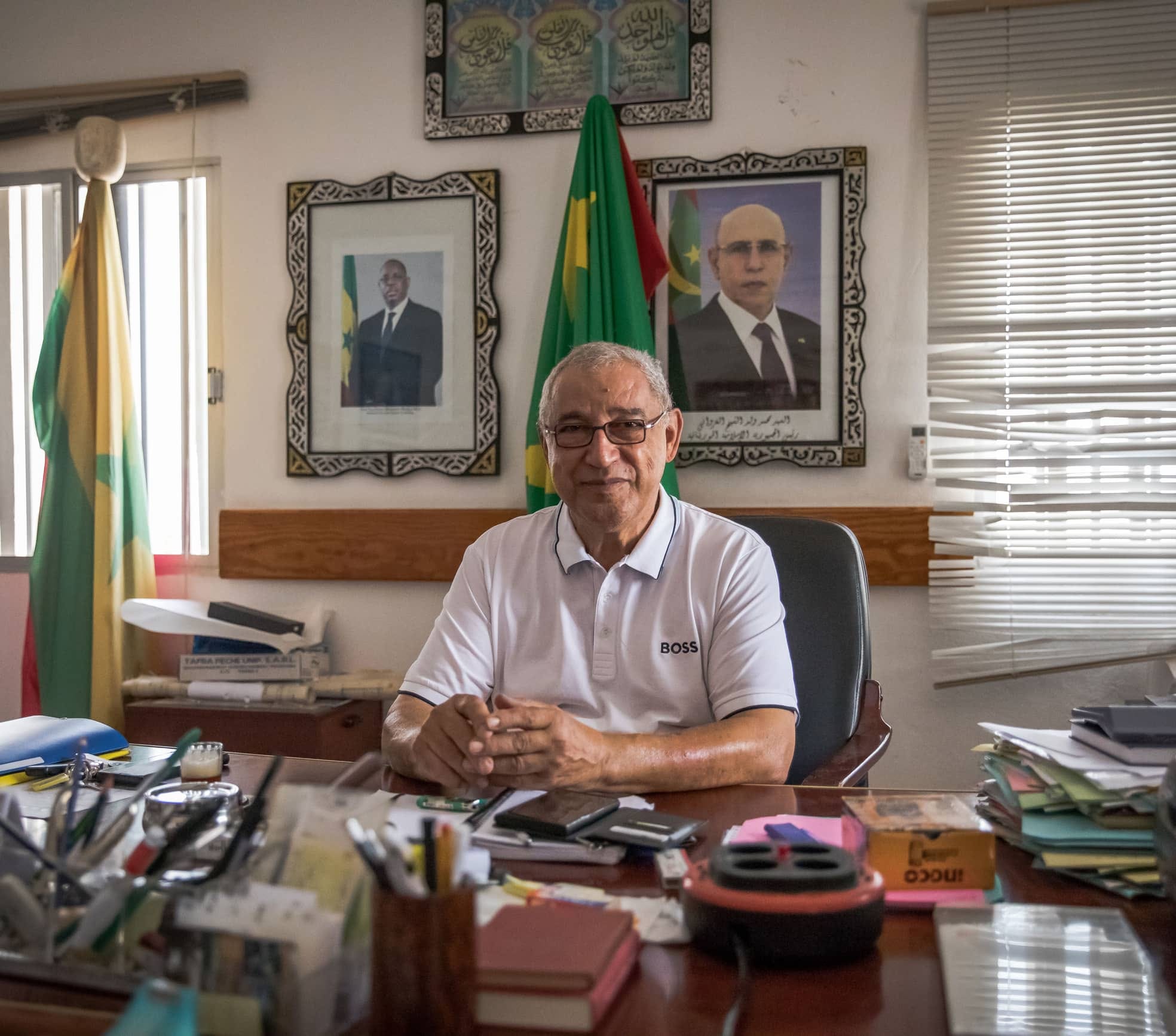
A production shutdown would cost his company millions of euros per day, he says, declining to give further financial details. His daughter Jamila Boughourbal guides visitors through the octopus processing plant in Nouadhibou’s industrial zone.
Before freezing, the animals undergo strict quality checks. Boughourbal emphasises that Japanese customers in particular demand high quality and visual perfection. An octopus with seven arms or damaged tentacles would never be purchased.
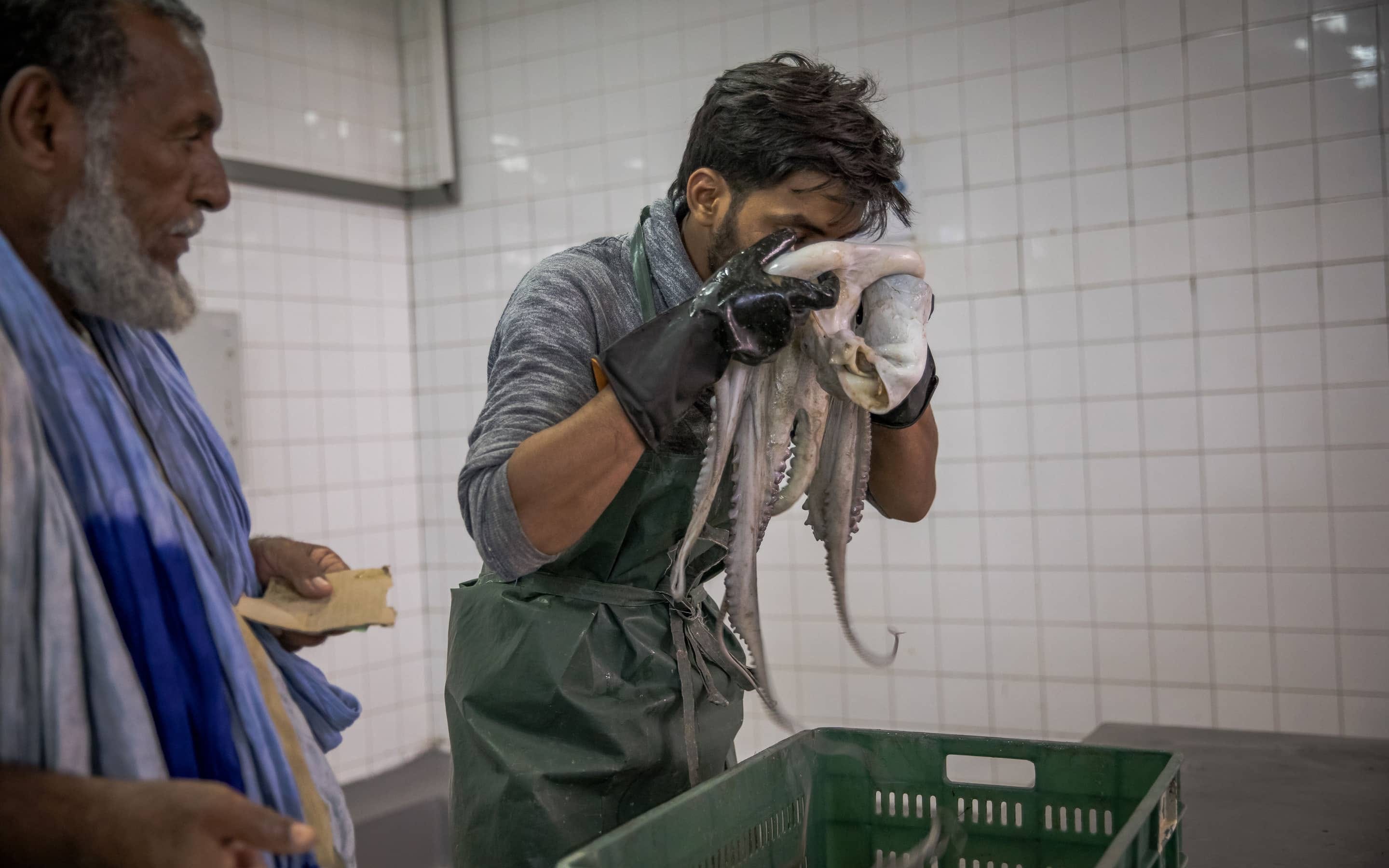
A man at the facility smells each individual octopus upon arrival.
If even a drop of petrol from a boat engine contaminates an octopus, Japanese importers reject the entire container shipment. As in Spain, the highest grade in Mauritania is called “Japanese quality.”
Japan
In Osaka, a port city in southern Japan, life truly begins at night. Crowds press beneath neon signs in the old town.


The air smells of takoyaki, a Japanese street-food specialty.
At packed stalls, people queue for fried octopus balls topped with fish flakes and sauce. In crowded izakayas, marked by red lanterns, chefs prepare octopus – grilled, boiled, as sashimi or salad. Nearly 40 percent of octopus imported to Japan comes from Mauritania, and is considered the best in the world.
Osaka’s nocturnal vibrancy contrasts sharply with the calm order of Edogawa City, a quiet residential district in Tokyo. Here lives the man behind the Mauritanian–Japanese connection.

Masaaki Nakamura sits surrounded by photographs and specialist books in his modest seventh-floor apartment. At 26, he first set foot in Mauritania. Now 73, he looks back and laughs at yellowed photos. “There was nothing there,” he says. “Nothing but desert.”
In 1976, after Mauritania’s first year of drought, Nakamura was sent as a volunteer by the Japan International Cooperation Agency to develop the fisheries sector. For six months, he scoured the coast searching for fishermen. He realised octopus would be easy to catch. At first, only ten men were willing to work with him. Locals found octopus disgusting.
Nakamura taught the traditional Japanese method of octopus fishing using small pots. Tied every two metres along a rope and lowered to depths of up to 30 metres, the pots exploit octopuses’ love of hiding places, allowing them to be hauled up alive. Mauritanians still use plastic versions of these pots today.
Nakamura now sees the darker side of Mauritania’s rapid fisheries expansion. He blames China for overfishing. “China has hundreds of trawlers off West Africa,” he says. “They steal all the resources.” Handing fisheries entirely to Mauritanians is the country’s only chance, he believes. He calls for unions to own factories and for trawler numbers to be reduced. He plans one final trip to Mauritania to advise unions. “We must act now,” he says.
Is Farming the Solution?
Pressure on octopus fisheries is growing. Since the 1960s, research institutes and companies have attempted to industrialise octopus farming. Today, more than half of the seafood we eat – mussels, shrimp, salmon – comes from aquaculture. At first glance, octopus seems ideal: fast-growing, short-lived, prolific breeders. But their complex life cycle is difficult to replicate in captivity.
In the wild, octopus are extreme loners, mating only once at the end of their lives. Females lay hundreds of thousands of eggs and guard them for months, dying once the young hatch. The larvae drift like plankton for one to two months, hunting live prey until their arms and suckers develop and they settle on the seabed. Few survive to adulthood in the wild and until recently, none in laboratories.
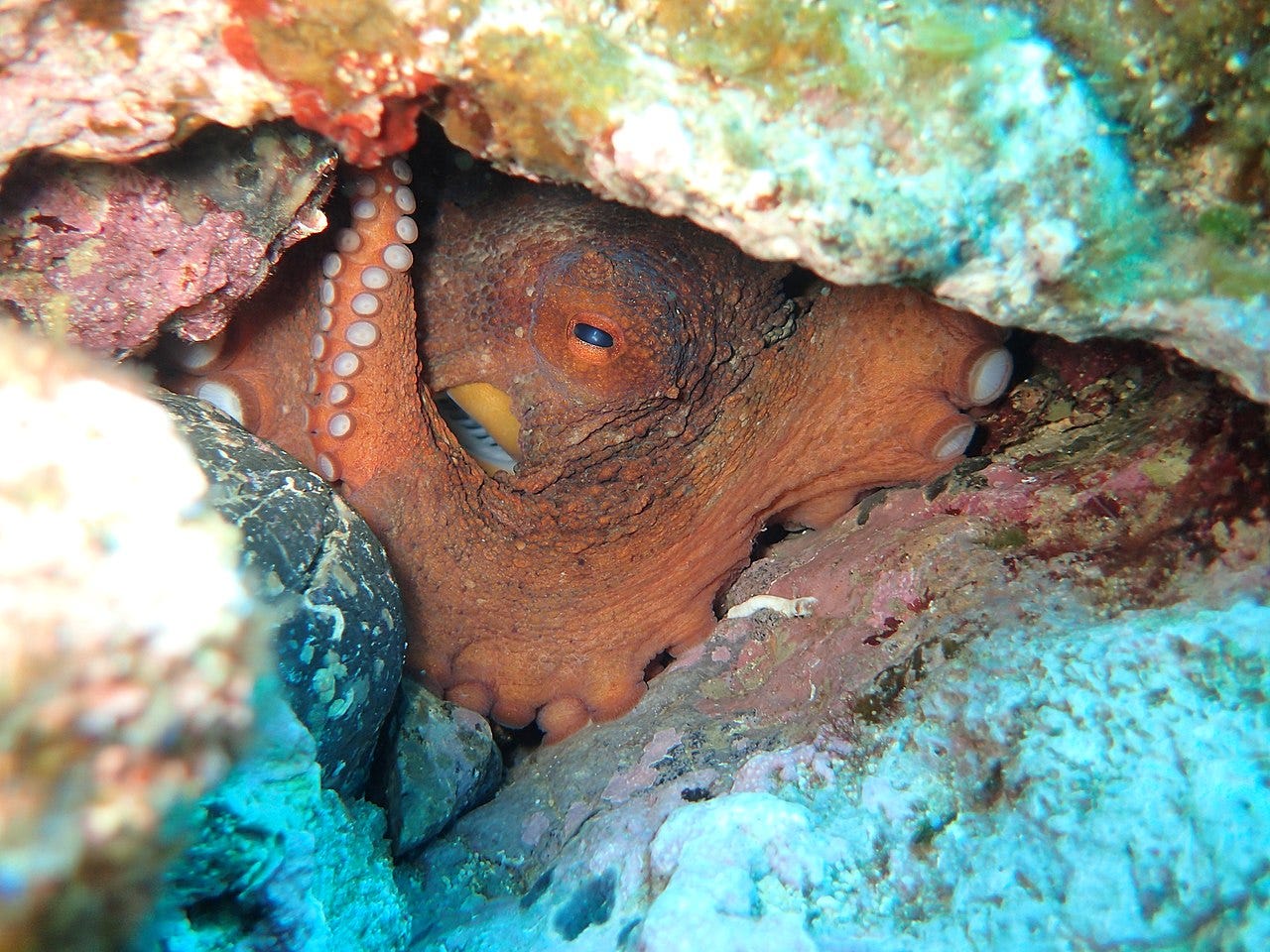
In 2019, Spanish company Nueva Pescanova announced a breakthrough in octopus farming, building on research by Spain’s Oceanographic Institute. Juvenile octopus survived as paralarvae for several months in laboratories. From 2023, the company planned to farm 3,000 tonnes of octopus annually off Gran Canaria. The plans sparked fierce debate.
Proponents claim mass farming could sustainably meet demand. Keri Tietge, octopus expert at animal welfare organisation Eurogroup for Animals, disagrees. “It’s claimed that aquaculture relieves pressure on wild populations. In reality, it fuels demand.” A 2019 study observed this effect in other fish species.
Industrial farming would also further burden marine ecosystems. Producing one kilo of octopus meat requires more than double or triple that amount in fish feed. About a third of global wild fish catches are currently processed into animal feed.
Octopus intelligence and solitary nature also make captivity ethically problematic. They possess short- and long-term memory, explore their surroundings, recognise individuals and may even dream.
Mass farming would cause suffering, says Tietge. High stocking densities are needed for profitability. In nature, octopus live alone in territories of up to 200 square metres. “They are not used to living together. In sterile tanks, they become stressed and bored, often turning aggressive.”
Studies show octopus feel pain and actively avoid it. They also display advanced cognitive abilities and respond to anaesthesia similarly to mammals, according to the US National Institutes of Health. In future, ethics approval may be required for cephalopod research in the US – previously only mandatory for vertebrates.
The EU Commission also plans to update animal welfare regulations by the end of 2023. Since 2010, the EU has classified octopus as sentient beings.
Despite opposition and financial difficulties, Nueva Pescanova continues to pursue its plans. The company declined visits and interviews. Available research results are sobering: captive-bred octopus appear less viable, many dying shortly after birth. As a result, the mass-farming project in Las Palmas is currently on hold.
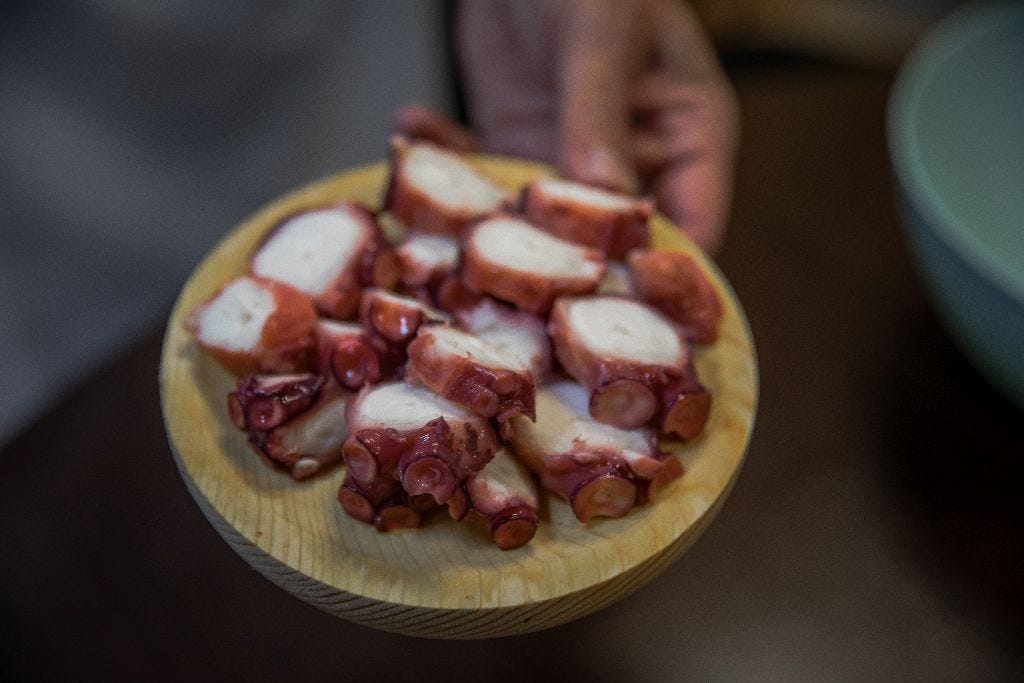
Daniel Atanes of A Pulpeira prefers not to comment on octopus farming, except to note that the company has “not produced a single kilo so far.” For him, quality matters: taste, aroma, colour and texture. “For me, octopus from Mauritania is simply the best in the world,” he says in the processing hall.
He takes an octopus arm from the microwave and snips it onto a cutting board with scissors. A drizzle of olive oil, salt and a pinch of paprika and the tasting is complete. The Mauritanian delicacy sits uneasily, long after the meal.
The story was supported by the Pulitzer Center.
What we are reading, watching and listening to
Nathalie is unexpectedly hooked on Andor – surprising, given that she’s never been much into Star Wars. But a good story is a good story. 👽
Ingrid is reading Trouble in Tbilisi: The Lack of Light, Nino Haratischwili’s story of friendship follows the lives of four women in the years following Georgia’s independence from the Soviet Union.
Tristen is watching Babylon Berlin, a series set in Berlin of the 1920s and 1930s. Crime, politics, history and the pychological impacts of the Great War. Morphine addicted lawman. Tsarist gold and the Fourth International. What’s not to like?
About Red Line
Nathalie, Ingrid and Tristen investigate underreported issues around the world, examining the political, economic and environmental forces that shape our lives. Their work focuses on democracy, culture and environmental crime. Through long-form reporting, documentary photography and multimedia storytelling, they trace power, follow the money and hold those responsible to account.
Got a story tip? Email us at: hello@redline-collective.org
Want to support our work? Please give us a coffee. Even better, subscribe!
I stopped eating octopus after reading two books about them, where I learned how intelligent and perceptive they are. The “octopuses are not food” decision was firmly sealed, however, when I watched “My Octopus Teacher.” How could anyone harm a tender, affectionate being like that?